
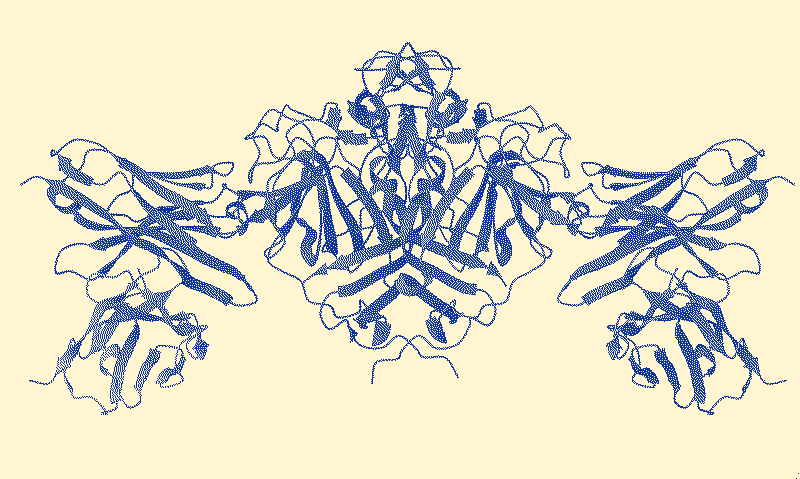
Viral spike proteins and envelope proteins control how viruses enter cells. Their job is to connect an external viral particle to a host cell and trigger entry.
To do this, they must solve a difficult structural problem. They need to remain stable while the virus is outside the cell, but also be able to undergo large shape changes when they encounter a host receptor. This creates a structure that is both stable and flexible depending on context.
Viral spike proteins behave more like machines than static objects, transitioning through multiple forms to solve a difficult structural problem.
The result is a class of proteins that behave more like machines than static objects. They transition through multiple forms: an initial binding state, an intermediate activated state, and a final fusion state where the viral and cellular membranes merge.
Because these proteins must be exposed to function, they are also vulnerable to binding by antibodies. When antibodies attach, they often lock the spike in one state and prevent it from completing its transition.
Evolutionary Convergence
Different viruses independently evolve similar solutions because they are solving the same constraint: how to enter a cell while remaining functional in an external environment. This leads to convergence on similar structural strategies even without shared ancestry.
For work relevant to Jäntra, the key idea is that structure alone is not enough to describe these systems. Their behavior is defined by transitions between states, not by any single shape. The important object is not a static structure, but a controlled transformation process.