
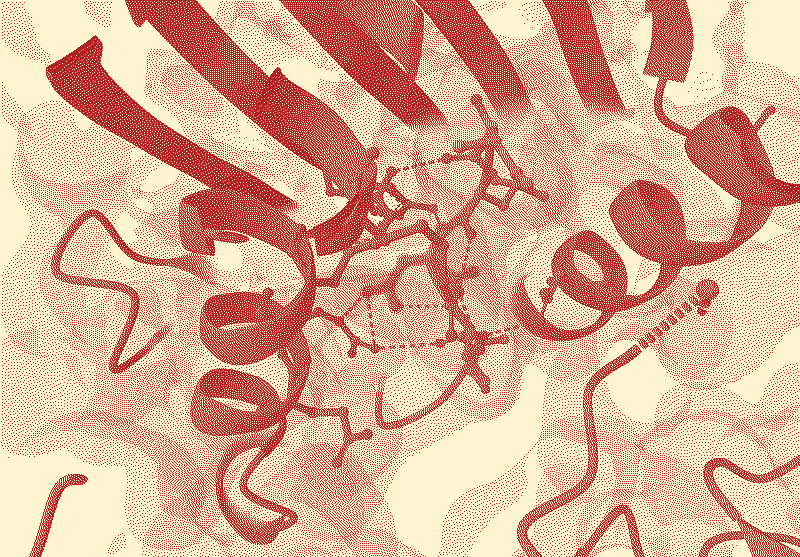
One example is the Ras family of proteins, including NRAS. These proteins act as molecular switches: they toggle between an active and inactive state depending on which nucleotide they are bound to. When mutations occur, such as Q61K, this switching mechanism can become disrupted, often locking the protein into a permanently active state.
However, the biological effect is not determined by this protein alone. Ras proteins function within larger systems that include membrane localization, recruitment of downstream partners, and transient assembly of signaling complexes. The outcome depends on how these interactions form and dissolve over time.
Cancer is not just a structural defect in one molecule — it is a failure of a distributed control system that normally maintains balance.
Regulation and Instability
In healthy cells, these assemblies are tightly regulated and transient. In cancer, this regulation becomes unstable. Complexes may assemble too easily, remain active too long, or fail to disassemble. This leads to a persistent signaling state that drives uncontrolled growth.
For Jäntra-relevant thinking, the important shift is from “what does this protein do?” to “how does this system decide?” Cancer is not just a structural defect in one molecule — it is a failure of a distributed control system that normally maintains balance.
In this sense, oncogenic complexes are not just targets for structure determination. They are points where biological decision-making becomes visibly unstable.