
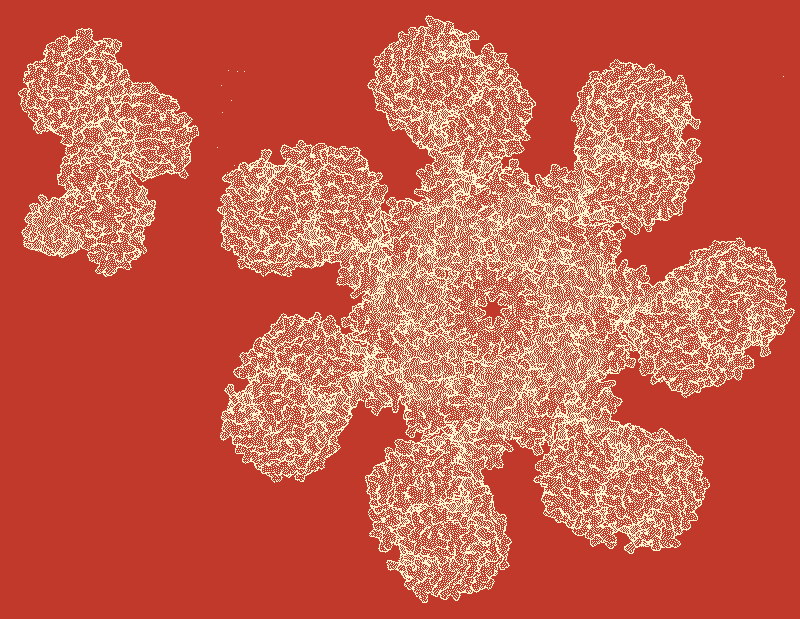
There is a hidden world inside every living cell — a world of machines. Not machines in any loose metaphorical sense, but literal mechanisms: protein assemblies that move, transform, and respond with a precision that still astonishes biologists who have spent decades studying them. They are called complexes, or assemblies, or molecular machines, and they are the operating layer of life.
An individual protein — a single folded chain of amino acids — is already remarkable. It folds from a one-dimensional sequence into a precise three-dimensional shape, and that shape is its function. But most of what a cell does, it does not do with lone proteins. It does it with groups. Two proteins docking together, or five, or twenty-seven, each contributing a surface, an active site, a hinge. Together they form something that neither could be alone.
The apoptosome shown above is one of the most dramatic examples. When a cell receives a signal that it should die — a controlled, necessary death, part of the body's ordinary maintenance — the protein Apaf-1 changes shape. Seven of these altered subunits find each other and lock together into a wheel. That wheel recruits and activates the enzymes that carry out apoptosis. Nothing about the individual subunit predicts the wheel. The wheel is the function.
The shape of a protein complex is not the sum of its parts — it is a new thing that emerges only when the parts are together.
The problem of quaternary structure
For decades, the central challenge of structural biology was the protein folding problem: given a sequence of amino acids, predict the three-dimensional structure of the resulting protein. AlphaFold largely solved this. Its predictions now match experimental structures with remarkable accuracy, and the field has been transformed.
But AlphaFold solved the monomer problem. The next frontier is quaternary structure — the structure of complexes. How do multiple proteins come together? What surfaces do they present to each other? What is the shape of the assembly they form, and how does it move? These questions remain substantially open.
The difficulty is not merely technical. Complexes are harder to crystallize and resolve experimentally. They are more numerous than individual proteins — the human cell may contain tens of thousands of distinct complexes. And the search space for how proteins might combine is astronomically large: predicting which proteins interact, where they bind, and what structure results involves a combinatorial problem that brute-force methods cannot address.
What we are building
At Jäntra, we are developing AI models specifically for this problem. Our approach begins with protein embeddings — dense numerical representations that encode the structural and functional properties of individual proteins. Over these embeddings, we apply clustering methods to organize the space of known proteins into groups of structural similarity, and then study the interaction patterns within and across those groups.
The goal is a model that can, given two or more proteins, predict whether they are likely to form a complex, where and how they will bind, and what the resulting quaternary structure will look like. We are training on the growing corpus of experimentally determined complex structures and designing architectures that can reason about symmetry, stoichiometry, and interface geometry in ways that existing tools do not.
This is hard. We do not expect a single model to solve the full problem. We expect, instead, a series of progressively better tools — each one expanding the boundary of what we can predict, and each one revealing new structure in the data that suggests the next question.
Why it matters
Most drugs work by binding to proteins. Most diseases involve proteins that are behaving incorrectly — misfolding, misbinding, forming complexes they should not form, or failing to form complexes they should. To design drugs that intervene precisely, you need to understand the complexes: not just the lone target protein, but the machinery it belongs to.
The same understanding matters for basic biology. We do not yet have a complete catalogue of the protein complexes in the human cell. We do not yet know, for most of them, what structural variation is tolerated, how they are regulated, or how they change across cell types and disease states. These are not obscure questions. They are the operating instructions for life, and we are still learning to read them.
The machinery is there, turning, inside every cell. We intend to make it visible.