
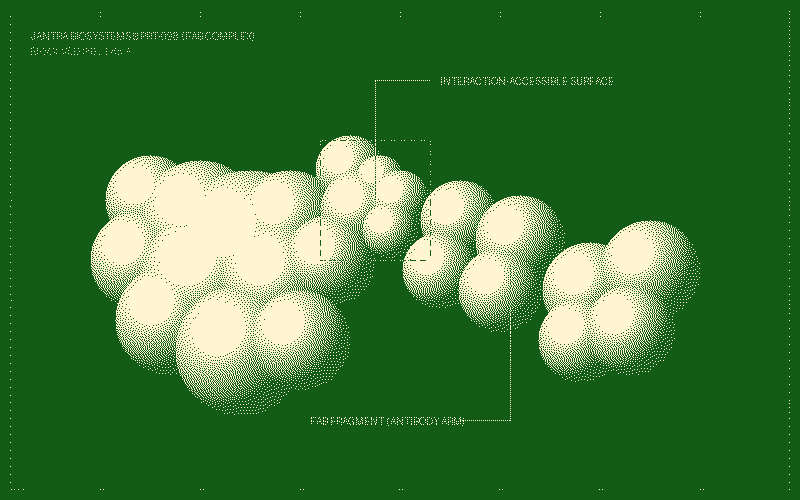
Fab fragments are small, engineered pieces of antibodies. An antibody is a Y-shaped immune protein, and a Fab fragment is essentially one “arm” of that Y — the part that physically binds to a target. In structural biology, Fab fragments are often used as binding partners that attach tightly to proteins of interest.
They are useful for a simple reason: many proteins are not stable or rigid enough to be studied on their own. They move between multiple shapes, and some of those shapes exist only briefly. When a Fab fragment binds, it can stabilize one of these shapes long enough for it to be measured.
When a Fab fragment binds, it can stabilize one of these shapes long enough for it to be measured — acting as a molecular stabilizing grip.
This turns Fab fragments into something like molecular stabilizing grips. They do not change the underlying biology directly — instead, they make certain protein states observable.
What is important is what they preferentially bind to. Fab fragments tend to attach to biologically meaningful surfaces: immune recognition sites, viral entry regions, enzyme interfaces, and regulatory contact points. These are exactly the regions where proteins interact with other proteins.
So the structures that become visible are not a random sampling of all possible shapes. They are biased toward surfaces that can be bound and stabilized.
For work relevant to Jäntra, this shifts the focus away from thinking of proteins as isolated folded objects. Instead, the relevant unit becomes the interaction-accessible surface — the parts of a protein that can actually participate in binding events.
Fab fragments are therefore not just experimental tools. They define a practical way of turning invisible, unstable protein behavior into readable structure.