
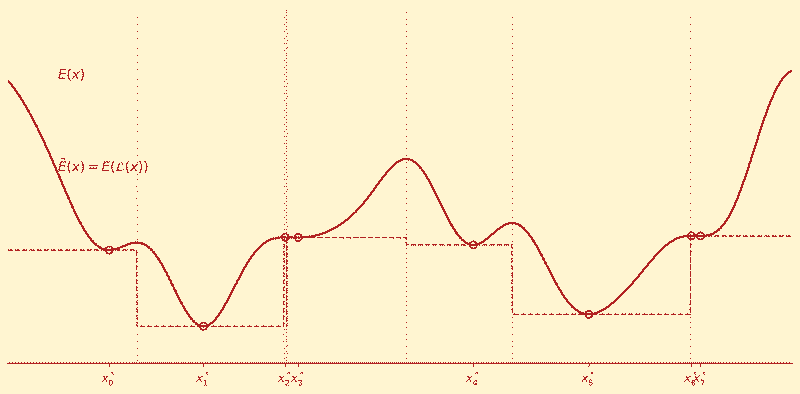
Monte Carlo Basin Hopping is a stochastic optimization method designed for rugged, high-dimensional energy landscapes. It is built on a simple idea: instead of trying to descend a complex landscape directly, repeatedly perturb the system and re-minimize locally.
Consider an energy function:
\[ E(x) \]where \(x \in \mathbb{R}^n\) represents a configuration in a high-dimensional space. The goal is to find:
\[ x^* = \arg\min_x E(x) \]In many realistic systems, \(E(x)\) is highly non-convex, containing many local minima separated by large barriers. Direct gradient descent tends to get trapped:
\[ \nabla E(x) = 0 \quad \text{(local minimum, not global)} \]Monte Carlo Basin Hopping reframes the problem by introducing a transformation of the energy landscape.
First, define a local minimization operator:
\[ x' = \mathcal{L}(x) \]where \(\mathcal{L}\) denotes a deterministic local optimizer (e.g., gradient descent, quasi-Newton methods). This maps any point to the nearest local minimum, effectively collapsing each basin of attraction into a single point.
We then define a transformed energy landscape:
\[ \tilde{E}(x) = E(\mathcal{L}(x)) \]In this representation, the system no longer explores continuous valleys—it jumps between basins.
The algorithm proceeds as follows:
- Start from an initial configuration \(x_0\).
- Apply a random perturbation: \[ x_{\text{trial}} = x + \delta x, \quad \delta x \sim \mathcal{N}(0, \sigma^2 I) \]
- Locally minimize: \[ x_{\text{min}} = \mathcal{L}(x_{\text{trial}}) \]
- Accept or reject the move using a Metropolis criterion: \[ P(\text{accept}) = \min \left( 1, \exp\left(-\beta \left[E(x_{\text{min}}) - E(x)\right]\right) \right) \]
where:
- \(\beta = \frac{1}{k_B T}\) is an inverse temperature parameter,
- \(k_B T\) controls exploration versus exploitation.
This creates a Markov chain over local minima rather than raw configurations.
Complexity is encoded in the connectivity between minima rather than the smoothness of the space itself.
The key conceptual shift is that the landscape is no longer viewed as continuous terrain, but as a set of basins:
\[ \mathcal{B}_i = \{ x \mid \mathcal{L}(x) = x_i^* \} \]Each basin collapses into a node in a graph, and Monte Carlo hopping becomes a stochastic walk over this reduced structure.
The acceptance rule ensures detailed balance:
\[ \pi(x) \propto e^{-\beta E(x)} \]so that in equilibrium, the system samples low-energy basins with higher probability.
From a geometric perspective, basin hopping transforms optimization from gradient flow into discrete exploration. Instead of asking how to descend a slope, the question becomes: how to move between regions of stability separated by barriers.
This perspective is particularly powerful in molecular systems, where energy landscapes are fractured, with many metastable states corresponding to different structural arrangements.
In this sense, Monte Carlo Basin Hopping is not merely an algorithm. It is a reframing of structure: from continuous surfaces to a landscape of attractors, where complexity is encoded in the connectivity between minima rather than the smoothness of the space itself.