For a point \(\mathbf{x}\), the Signed Distance Function is defined as:
\[ \phi(\mathbf{x}) = \begin{cases} -d(\mathbf{x}, \partial\Omega), & \mathbf{x} \in \Omega \\ 0, & \mathbf{x} \in \partial\Omega \\ +d(\mathbf{x}, \partial\Omega), & \mathbf{x} \notin \Omega \end{cases} \]where:
- \(\Omega\) is the object,
- \(\partial\Omega\) is its boundary,
- \(d(\mathbf{x}, \partial\Omega)\) is the shortest distance from \(\mathbf{x}\) to the surface.
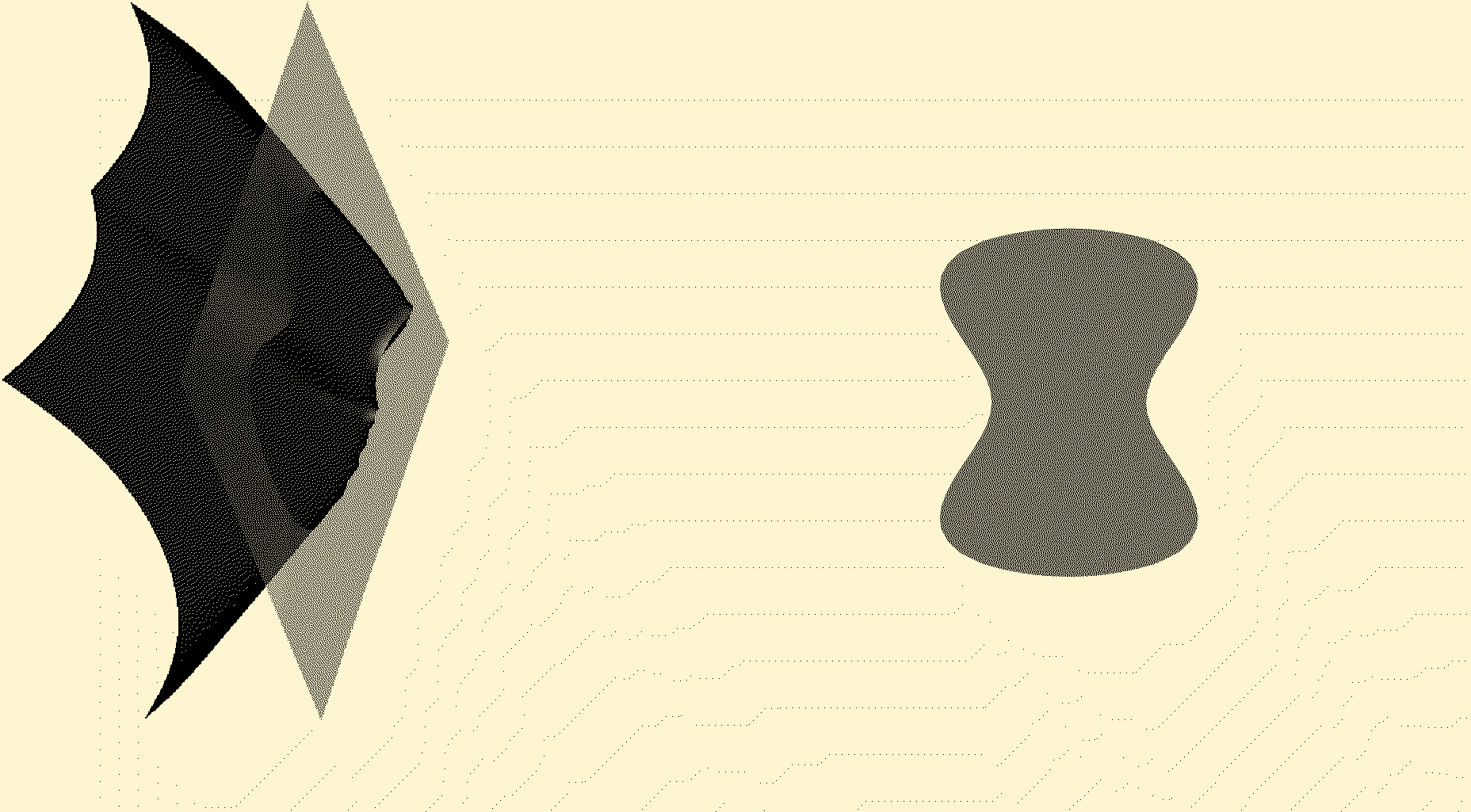
The surface itself is therefore not stored explicitly. It emerges as the zero-level set:
\[ \partial\Omega = \left\{ \mathbf{x} \;\middle|\; \phi(\mathbf{x}) = 0 \right\} \]This is a profound shift in perspective. The object is no longer represented by its boundary. Instead, the boundary appears naturally from a continuous scalar field defined throughout space.
A true signed distance field satisfies:
\[ |\nabla \phi(\mathbf{x})| = 1 \]almost everywhere.
The gradient points in the direction of greatest increase and defines the local surface normal:
\[ \mathbf{n} = \frac{\nabla \phi}{|\nabla \phi|} \]As a result, geometry, orientation, and distance become different aspects of the same underlying field.
For complex biological assemblies, each protein subunit may be represented as an individual signed distance field:
\[ \phi_i(\mathbf{x}) \]and combined through constructive operations. The union of multiple structures can be expressed as:
\[ \phi_{\text{union}}(\mathbf{x}) = \min_i \phi_i(\mathbf{x}) \]while their intersection is:
\[ \phi_{\text{intersection}}(\mathbf{x}) = \max_i \phi_i(\mathbf{x}) \]The resulting field describes not merely where components exist, but how their geometries interact throughout space.
The boundary appears naturally from a continuous scalar field defined throughout space.
From this perspective, a protein complex is not fundamentally a collection of atoms, residues, or chains. It is a geometric field whose structure emerges from the interaction of other fields. Shape becomes a continuous quantity rather than a discrete object.
The Signed Distance Function suggests a broader principle. A form need not be described directly. It may instead arise as a boundary within a deeper field. The visible structure is merely the zero crossing of a more fundamental spatial relationship.